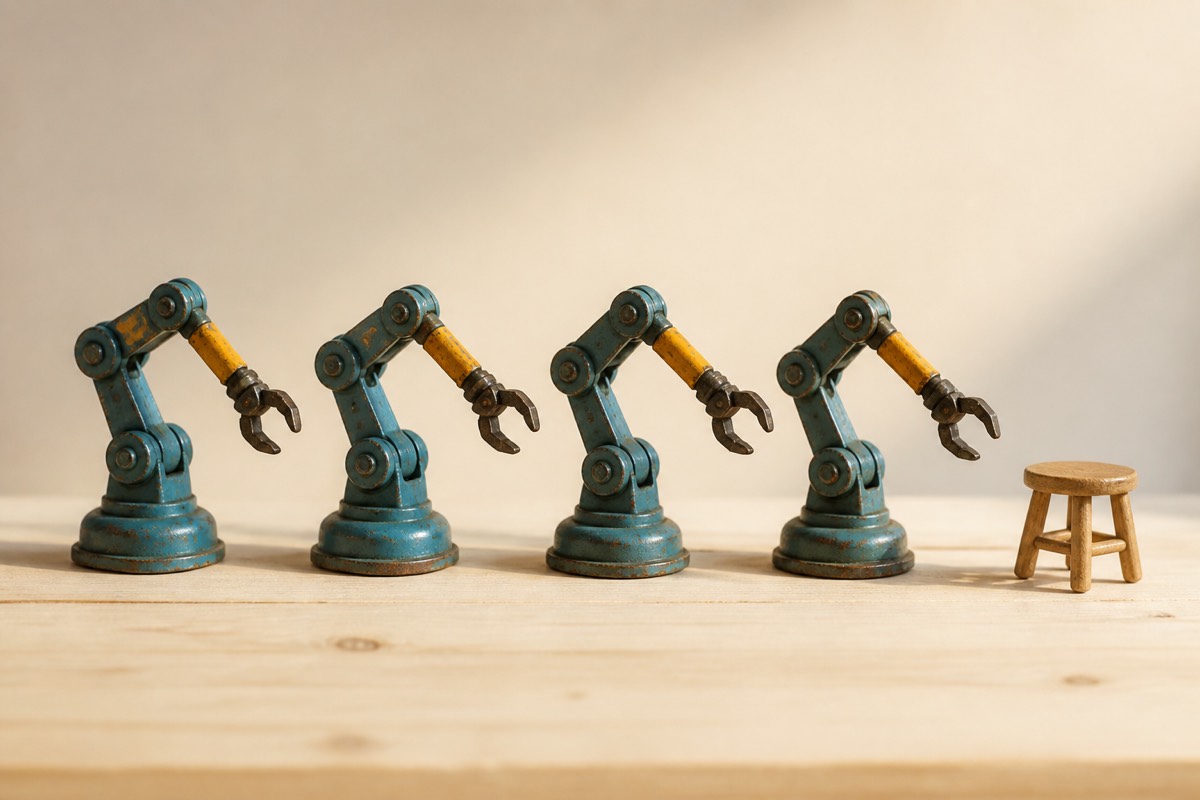
A CV does not show who can run a robot. Every factory buying one now needs somebody who can make it work, and nobody has built a way to tell who that is. So we do: engineers take real missions, the run is filmed, and it is graded against rules written with the companies who will be hiring. Factories hire from the footage. Making the engineers is how the supply arrives — the record is what gets sold.
concept film — one mission run, one demonstration recorded
Build the arm, make it gently pat your back. A warm first win.
Grab an object, move it. The "Hello World" of manipulation.
The robot moves while you speak, freezes the instant you stop. The one Squid Game made famous.
Most of what we build is software — SaaS, internal automation, AX. And that work is being done by Claude and ChatGPT and Gemini now, precisely because it is software. When making software becomes a commodity, what is left is the side with a body.
And that side just became addressable. Five years ago, telling a robot "move that box over there" did nothing at all — the same way talking to AI did nothing before LLMs. Now you do that ten times a day. The equivalent shift is happening in robots right now, and it has one name worth learning: VLA.
Korea is where you would test it. 1,220 robots per 10,000 manufacturing workers — first in the world, four times the US and nine times the global average (IFR World Robotics 2025). The government has written "first in the world in Physical AI by 2030" into national policy. The testbed is already here.
So here is the bottleneck. Companies want to hire AI forward deployed engineers right now and cannot — not for lack of budget, but because they cannot tell candidates apart. There is no track record to read: the role is too new for anyone to have ten years of it, so a CV does not discriminate. Which is why they run hackathons. That is the market admitting, in public, that it cannot see this on paper.
Physical AI makes it worse. The hardware differs from shop to shop, so even two people with real experience have experience that does not compare. So the question a hiring manager is actually stuck on is not "where do I find them" — it is "how would I recognise one?"
The people are already here. The same commoditization that started this left the largest pool of retrainable engineers there has ever been. Someone who can debug a distributed system is most of the way to debugging a robot cell. What is missing is not aptitude — it is a path, and a way to prove you walked it.
So we run that hackathon permanently. It starts in a simulator and ends on an open-source arm, and every attempt stays on video. Nothing to be intimidated by — it is built to be fun. And the footage is exactly the thing a hiring manager could not get otherwise: a dated, watchable record of a person doing the actual work, judged by people who tried the same task. École 42 already proved a peer-reviewed, degree-free record can carry weight in a real labour market; two of us spent two years inside it.
enterprise AI spending in 2026, up 34.8% from $302B
of enterprises are raising their AI budget this year — about 2% are cutting
AI specialists Korea's new KDT "AI Campus" track aims to train in 2026, at zero self-pay
Run a robot-arm challenge — in sim today, on real hardware later.
Output → one attempt, timestamped.
Drop the clip. The takes that failed count too — those are the ones the models never get to see.
Output → one attempt on video, failures included.
You judge other people's runs; they judge yours. École-42 style — no lecturer, no answer key.
Output → a judgement from someone who tried the same task.
The runs that survive review take pole. Rankings move. The record does not.
Output → a proof-of-work record no résumé can fake.
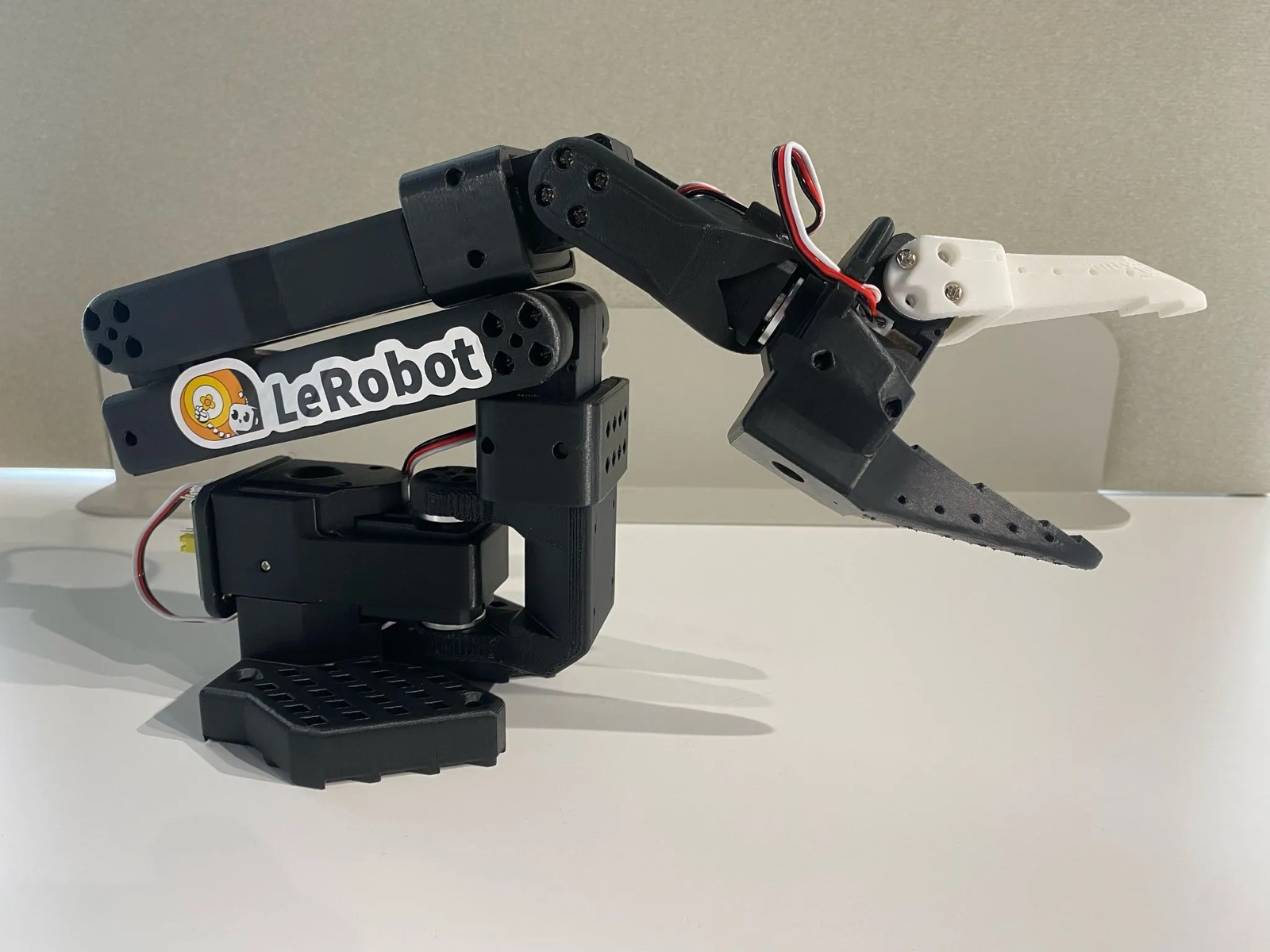
No RC car, really — the missions run on the SO-101, the low-cost, open-source 3D-printed robot arm from the Hugging Face LeRobot ecosystem. Learn it in simulation on your own laptop first; buy the arm only when you're ready. That is the whole thesis in hardware form: the arm the big labs treat as a toy is the one anyone can own, print and break. Cheap, open and everywhere beats expensive, closed and rare — it is the only way this data gets made by more than five companies.
6-DOF · open-source (Apache-2.0) · a few hundred dollars · Mac-friendly sim path
SO-101 photo © The Robot Studio / Hugging Face — SO-ARM100, Apache-2.0
Mission 2 — pick & place, on the playroom floor
Harder tracks — new worlds to masterNobody grades you from above. You review other people's runs, they review yours, and the ones that earn the most reviews rise. A mission video gets copied in a day. A review record does not.
↑ illustrative — the real gallery fills up as runs come in.
A six-week season for your own software engineers. They come out able to deploy and debug a robot cell — no req to open, no relocation, no headhunter fee.
Every attempt is on video and peer-reviewed, so readiness is something you watch rather than something a certificate asserts. You know who to put on the line before you put them there.
Bring the cell that keeps stopping. The season is built around it, so what you get back is a team that has already solved your specific problem — not a generic curriculum.
We write the marking criteria with the people who do the hiring. So the record is already in your language before you read it, and a rank means what you meant by it.
Early, and built in the open — open an issue and we will tell you exactly what exists today.
Everything here is being built in the open, and player number one is the person building it — the arm gets bought, assembled and broken on camera, and every place it gets stuck becomes the next mission. Come build it with us →