Physical Spark · company

We make Physical AI
field engineers.

Physical Spark is where a Physical AI field engineer gets made — and proves it. Companies are hiring for this role right now and cannot tell candidates apart, because nobody has ten years of a job that is two years old. Their workaround is the hackathon. We run that hackathon permanently: robot-arm missions in a simulator, then on a real open-source arm, every attempt on video and peer-reviewed. The footage is what a hiring manager could not get any other way.

A permanent hackathon.
Companies already run hackathons because they cannot tell these candidates apart. We run one that never stops.

The gap

Two sides, both stuck. Neither can reach the other.
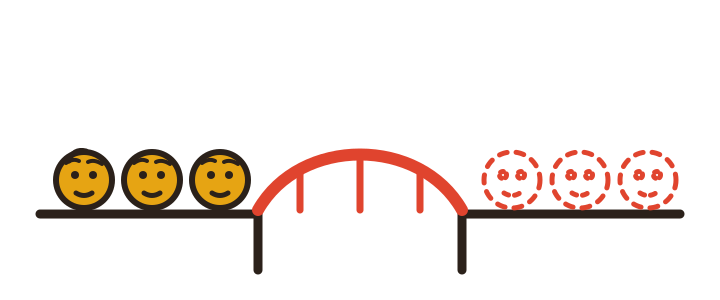
Real people stranded on one cliff edge and unfilled roles drawn as dashed outlines on the other, with a red arch spanning the gap between them

left: people who want the work · right: roles nobody can fill · centre: nothing

Developers cannot cross

In February 2026 software companies lost more than $1 trillion of market value in seven days — the worst selloff in over a decade, on the fear that agents replace the products companies used to buy. The work is moving from building a product to deploying one inside somebody else's building.

That is a different job, and nothing on a CV proves you can do it. The coding test cannot help: it measured exactly the part AI now does for you.

Companies cannot hire

Plans to hire forward deployed engineers went from 5–10% of companies to 70% inside two quarters (TechCrunch, Jul 2026). The same reporting counts roughly 17,000 on the US market and about 2,000 who can actually deliver.

And for the first time on record, AI skills are the hardest thing on earth to hire — across 39,063 employers in 41 countries (ManpowerGroup 2026).

And robotics has a second problem software does not

To practise AI engineering you need an API key and a laptop; you can build something tonight. To practise robotics you need hardware, somewhere to put it, and someone to tell you what to learn first — and nobody grades your run, so you cannot tell whether you are improving.

That is why developers do not cross. It is not nerve. There is no way in. Building one is the product.

Now
the gap is AI transformation. Companies want engineers who can put a model into a business, and run hackathons because a CV will not tell them who can.
Next year
the same gap, with hardware in it. Every shop floor is different, so even two experienced candidates have experience that does not compare.
Us
a hackathon that never ends. Every attempt recorded, so both sides can finally see each other.

Why now

The market already admitted it cannot tell these people apart.

The role arrived before the pipeline

Robot bodies got cheap and VLA made them addressable in language. So companies started hiring AI forward deployed engineers — and stalled, because nobody has ten years of a role that is two years old. A CV cannot discriminate.

Their workaround is the hackathon. We do not have to argue that hiring is broken here; the hackathon is the industry saying so out loud.

Physical makes it harder, and Korea makes it urgent

Shop-floor hardware differs everywhere, so two experienced candidates have experience that does not even compare. The question stops being where do I find one and becomes how would I recognise one.

Korea runs 1,220 robots per 10,000 manufacturing workers — first in the world, four times the US (IFR 2025), with "first in Physical AI by 2030" written into national policy. The testbed and the demand are in the same country.

Business model

We find Physical AI engineers by making them.

By the time we introduce somebody, the judgement has already happened — so what a company receives is not a CV and a phone call. A list of attempts, on video, graded by peers against criteria we write with the companies who will be doing the hiring. Only one of the three layers below charges anybody. The other two are what makes that one possible, and what comes after it.

  1. 1 The leaguefree · this is supply, not revenue Anyone can start tonight in the simulator, at no cost, and nothing stands between a developer and their first run. The players grade each other, so the expensive part of assessment is done by the people being assessed. Our only cost that grows with scale is servers. A paid tier for people who want more is intended, and is not built.
  2. 2 Placementrevenue now A manufacturer that cannot fill a role gets a shortlist of people whose work they can already watch. We are paid 40% of first-year salary, on placement, only when somebody actually starts — double what an ordinary search firm takes, because an ordinary search firm finds a person the market has already judged, and this market has made no judgement at all. We build the course, run the season and produce the evidence, which is the hire-train-deploy end of the business and prices at 40–60%. Either way it is a hiring budget, already committed to a seat sitting empty, not a training budget that gets cut in a bad year.
  3. 3 Assessmentthe business we are building Once our ranking has been tested against real jobs, companies stop hiring us to place and start paying to run the assessment themselves, priced per candidate. That is the better business — it recurs, and it is priced like software rather than like a service — but it needs hiring volume that does not exist yet. Karat built exactly this in Seattle for software engineers and was worth $1.1B in 2021. Nobody has built it for the people who deploy robots. The placements above are how we earn the right to.

Why this is one business, not three

The product is a person who can do the job. Layer 1 is where that person turns up and where the evidence about them gets made, which is why it has to be free — a toll at the door shrinks the only thing that matters, which is how many people walk in. Layer 2 is the company that needs one of them paying us once, at the moment they hire. Layer 3 is a company paying to point the whole thing at a problem it already has.

And we do not decide alone what good looks like. The marking criteria are written with the companies who will be hiring, so the record is already in their language before they read it. That is also why layer 3 cannot start on day one: you get to co-write a rubric once you have something worth showing.

We are not a data company. Every run leaves a dated, reviewed video behind, and that archive is real and it compounds — but its job is to make the ranking impossible to fake, not to be sold by the trajectory. Sell the footage and we are competing with people who raised tens of millions to collect it. Sell the engineer and we are the only ones doing it.

Layer 1 is free, and layer 3 is not priced here because it does not exist yet. The single number on this page — 40% of first-year salary — sits inside the 40–60% band that hire-train-deploy and staffing businesses charge when they carry the cost of producing the candidate, rather than the 15–25% an ordinary search firm takes for finding one. Earlier thinking on season pricing is kept on the market page as a record of first-season numbers, not as a rate card.

Team

Two people who have spent their careers on one question: can this person actually do the thing?

Jungmin Hong
Chief Executive Officer

Has spent close to a decade turning hard technical subjects into something a working adult can actually finish — writing the material, designing the assessment, and watching exactly where people drop out. Currently a lead AI instructor at Eduwill, teaching AI at national scale. Before that, an AI Platform Engineer at Upstage, Korea's document-AI unicorn, which is where the requirements of the people training the models stopped being abstract. Now runs that same loop on robot arms: design the mission, design the proof, watch the drop-off.

Gichan Lee
Chief Product Officer

Owns what gets built and what gets cut — and is the customer in our own pitch. Leads the AX team at KIBA, putting models into organisations that did not previously have any, and has spent this year trying to hire exactly the engineer described above without success. Trained in industrial engineering, which is the discipline of production lines and process rather than of software — the side of this problem that most people building developer tools have never worked on. Also builds the relationships the seasons run on: the labs, programs and developer communities that turn a mission into a sponsored benchmark, and a benchmark into a hiring pipeline.

Roadmap

Written as states, not dates.

What is shipped, and what is not

Everything above that is not shipped is written as an intention, not a claim. What is shipped is linked: the landing page, the missions, and the market analysis with its sources. We have no user numbers, no completion rates and no partnerships to report yet — when we do, they will appear here with a date on them.

Read the project

Everything we know, in the order it makes sense.

Four stops, top to bottom, and you have the whole picture. Most take five to ten minutes.

1

Where this gets sold ~8 min · market

Who pays for this in Korea, the US and Singapore — three different engines, every figure sourced. Including the place the standard advice turns out to be wrong.

2

The 60-second pitch 1 min · the whole thing

Six beats, each with a time budget. The fastest complete version of the argument, built to be read aloud rather than skimmed.

3

Run a mission yourself hands-on · sim first

Three robot-arm missions on a laptop simulator — no hardware needed to start. Progress saves as you go.

4

The Playbook docs · research

Product concept, market scans, field basics, decision records and lab notes on one board — the working material behind every page above. New to robotics? Start at knowledge/.